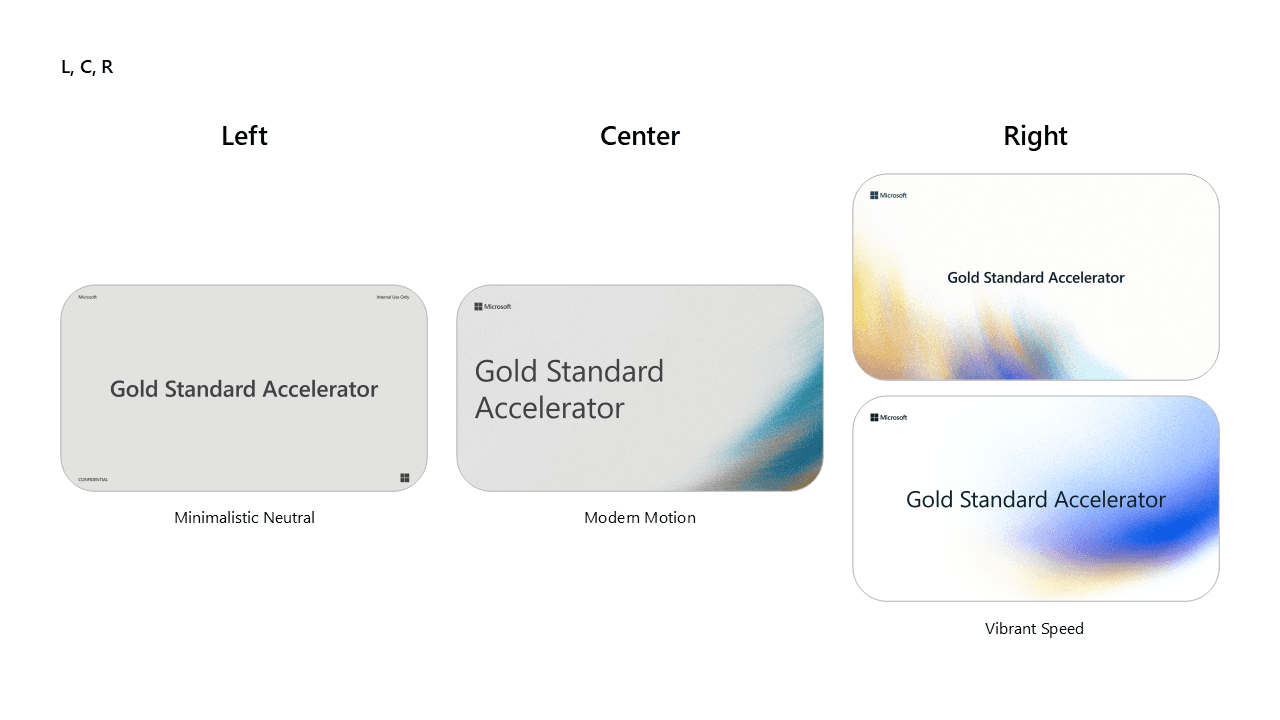
MICROSOFT · GOLD STANDARD ACCELERATORS · SCALE AI SOLUTIONING

GSA / SAS Brand System for AI Solution Accelerators

GSA / SAS Brand System for AI Solution Accelerators

GSA / SAS Brand System for AI Solution Accelerators

Building a Microsoft-native brand and presentation system from GSA to SAS, then applying the completed system across seven field-ready AI solution decks.

Building a Microsoft-native brand and presentation system from GSA to SAS, then applying the completed system across seven field-ready AI solution decks.

Building a Microsoft-native brand and presentation system from GSA to SAS, then applying the completed system across seven field-ready AI solution decks.

Overview

A template can standardize structure, but it cannot govern every interpretation. As GSA use expanded, the portfolio needed shared visual principles, application rules, and production tools that could preserve consistency across different AI solutions, creators, audiences, and customer conversations.

The work evolved from a reusable field-enablement template into an interim GSA visual system, then into the broader SAS brand and presentation system.

After the SAS guidelines and reusable PowerPoint template were completed, I applied the system across seven Solution Accelerator decks totaling 151 slides. The completed portfolio was distributed through Seismic to support field discovery and reuse.

System Type

Brand & Presentation System

System Type

Brand & Presentation System

Role

I created the initial GSA presentation template and later led the visual-system work across the broader branding initiative.

My contribution included independent design research, visual direction, identity development, typography, color, key art, brand guidelines, presentation architecture, and reusable layouts.

During the SAS phase, I continued to lead visual direction, presentation architecture, guideline design, and template production in partnership with Principal Designer Noah Pashley, who primarily developed the voice and contributed ongoing critique.

After the SAS system and template were completed, I applied the system across seven field-ready Solution Accelerator decks totaling 151 slides.

Audience

Microsoft sellers, account teams, technical field roles, solution owners, and creators responsible for introducing, adapting, and delivering AI solution accelerator stories in internal and customer-facing conversations.

Scope

An initial GSA field-enablement template, an interim GSA visual identity and guideline, a broader SAS brand guideline and reusable PowerPoint template, seven directly designed Solution Accelerator decks totaling 151 slides, and Seismic distribution.

Tools / Methods

PowerPoint

PowerPoint

Midjourney

Midjourney

Adobe Photoshop

Adobe Photoshop

Adobe Illustrator

Adobe Illustrator

Figma

Figma

Microsoft Brand Central

Microsoft Brand Central

Brand principles

Brand principles

Microsoft sub-brand benchmarking

Microsoft sub-brand benchmarking

Presentation-system architecture

Presentation-system architecture

Modular layout design

Modular layout design

Typography and color systems

Typography and color systems

Key art development

Key art development

Information visualization

Information visualization

Accessibility guidance

Accessibility guidance

Design & technical collaboration

Design & technical collaboration

01 / THE FIRST SYSTEM

A shared foundation for field-ready solution stories

Before the visual identity, there was a shared storytelling structure.

INITIAL FIELD STORY ARCHITECTURE

DEFINE

Audience,
owner, usage

HUMANIZE

Persona,
challenge, goal

PROVE

System and architecture

DEMONSTRATE

Product
experience

01 / DEFINE

Establish who the asset is for, how it should be delivered, and when it should be used.

02 / HUMANIZE

Frame technical capability through a specific user, problem, and desired outcome.

03 / PROVE

Give technical stakeholders a consistent view of how the solution works.

04 / DEMONSTRATE

Pair a product screen with talk track, business value, and technical context.

INITIAL FIELD STORY ARCHITECTURE

DEFINE

Audience,
owner, usage

HUMANIZE

Persona,
challenge, goal

PROVE

System and architecture

DEMONSTRATE

Product
experience

01 / DEFINE

Establish who the asset is for, how it should be delivered, and when it should be used.

02 / HUMANIZE

Frame technical capability through a specific user, problem, and desired outcome.

03 / PROVE

Give technical stakeholders a consistent view of how the solution works.

04 / DEMONSTRATE

Pair a product screen with talk track, business value, and technical context.

INITIAL FIELD STORY ARCHITECTURE

DEFINE

Audience,
owner, usage

HUMANIZE

Persona,
challenge, goal

PROVE

System and architecture

DEMONSTRATE

Product
experience

01 / DEFINE

Establish who the asset is for, how it should be delivered, and when it should be used.

02 / HUMANIZE

Frame technical capability through a specific user, problem, and desired outcome.

03 / PROVE

Give technical stakeholders a consistent view of how the solution works.

04 / DEMONSTRATE

Pair a product screen with talk track, business value, and technical context.

Gold Standard Accelerators needed a repeatable way to package distinct AI solutions for sellers and technical teams.

I created the first GSA PowerPoint template, defining a common content architecture and reusable layouts for audience guidance, business value, personas, scenarios, technical architecture, repository access, and product demonstrations.

02 / THE LIMITS OF REUSE

A template could scale reuse, but not govern interpretation

A template could scale reuse, but not govern interpretation

A template could scale reuse, but not govern interpretation

Templates enable reuse. Brand systems guide interpretation.

FROM TEMPLATE TO BRAND MANDATE

Scale exposed the need for shared visual rules.

01 / SHARED TEMPLATE

One reusable starting point

A common structure for packaging field-ready solution stories.

Shared structure

Reusable layouts

Field guidance

02 / INTERPRETATION PRESSURE

More use created more local decisions
Each new application introduced choices the template alone had not fully defined.

Typography

How is hierarchy defined?

Color

What carries meaning?

Key art

What creates recognition?

SHARED TEMPLATE

Common content and layout structure

Components

How should patterns behave?

Layout

What remains on-system?

Applications

How does it
extend?

The template defined what to include, but not yet how every application should express the portfolio.

03 / FORMAL BRAND MANDATE

Design leadership expanded the brief

DESIGN QUESTION

How do we maintain a consistent brand and delightful design across all GSA products?

EXPANDED SCOPE

Brand guidelines

Design system

Presentation template

Internal hub

Email templates

Landing-page expression

The assignment moved from template maintenance to a broader visual system.

THE SHIFT

FROM

A reusable
presentation template

TO

A governed visual system
for a growing portfolio

The problem was not variation. It was the absence of shared rules for managing it.

FROM TEMPLATE
TO BRAND MANDATE

Scale exposed the need for shared visual rules.

01 / SHARED TEMPLATE

One reusable starting point

A common structure for packaging field-ready
solution stories.

Shared structure

Reusable layouts

Field guidance

02 / INTERPRETATION PRESSURE

More use created more local decisions
Each new application introduced choices the template alone had not fully defined.

Typography

How is hierarchy defined?

Color

What carries meaning?

Key art

What creates recognition?

SHARED TEMPLATE

Common content and layout structure

Components

How should patterns behave?

Layout

What remains on-system?

Applications

How does it
extend?

The template defined what to include, but not yet how every application should express the portfolio.

03 / FORMAL BRAND MANDATE

Design leadership expanded the brief

DESIGN QUESTION

How do we maintain a consistent brand and delightful design across all GSA products?

EXPANDED SCOPE

Brand guidelines

Design system

Presentation template

Internal hub

Email templates

Landing-page expression

The assignment moved from template maintenance to a broader visual system.

THE SHIFT

FROM

A reusable
presentation template

TO

A governed visual system for a growing portfolio
The problem was not variation.
It was the absence of shared rules for managing it.

FROM TEMPLATE TO BRAND MANDATE

Scale exposed
the need for shared visual rules.

01 / SHARED TEMPLATE

One reusable starting point

A common structure for packaging field-ready solution stories.

Shared structure

Reusable layouts

Field guidance

02 / INTERPRETATION PRESSURE

More use created more local decisions
Each new application introduced choices the template alone had not fully defined.

Typography

How is hierarchy defined?

Color

What carries meaning?

Key art

What creates recognition?

SHARED TEMPLATE

Common content and
layout structure

Components

How should patterns behave?

Layout

What remains on-system?

Applications

How does it extend?

The template defined what to include,
but not yet how every application should express the portfolio.

03 / FORMAL BRAND MANDATE

Design leadership expanded the brief

DESIGN QUESTION

How do we maintain a consistent brand and
delightful design across all GSA products?

EXPANDED SCOPE

Brand guidelines

Design system

Presentation template

Internal hub

Email templates

Landing-page expression

The assignment moved from template maintenance to a broader visual system.

THE SHIFT

FROM

A reusable
presentation template

TO

A governed visual system for a growing portfolio

The problem was not variation.
It was the absence of shared rules for managing it.

As the template was reused across more solutions and creators, its layouts and visual elements were increasingly modified and reinterpreted.

At the same time, GSA assets were becoming more visible and important. Design leadership recognized that the portfolio needed shared visual rules that could preserve consistency without making every solution look identical.

03 / FORMALIZING THE BRAND

Researching a
Microsoft-native expression

Researching a
Microsoft-native expression

Researching a Microsoft-native expression

Distinctive enough to be recognizable. Governed enough to remain unmistakably Microsoft.

With the mandate established, I independently benchmarked Microsoft Copilot, Healthcare, Power Platform, Kumo, and Visual Studio to understand how Microsoft systems balance distinctive expression, enterprise credibility, and shared governance.

The research was translated into three operating requirements and five GSA brand positions: Speed, Scale, Premium, Momentum, and Modular. These became practical criteria for hierarchy, consistency, craft, progression, and reusable production.

FROM BENCHMARKS TO BRAND BEHAVIOR

A Microsoft-native expression needed both inheritance and restraint.

Five benchmark systems clarified what GSA should adopt, avoid, and formalize.

01 / OPERATING REQUIREMENTS

REQUIREMENT 01

Competitive quality

Benchmark leading Microsoft sub-brand systems and meet their standard of clarity, governance,
and polish.

REQUIREMENT 02

Microsoft integration

Inherit Microsoft foundations across typography, color, layout grids, and iconography.

REQUIREMENT 03

Expressive clarity

Make transformation, speed, scale, and clarity explicit through rules and examples.

02 / MICROSOFT BENCHMARKS

Benchmark

Microsoft Copilot
Brand Expression

What It Proved

A distinctive signature can scale when it is supported by tight constraints and clear usage rules.

GSA Application

Limit signature elements and codify their usage, motion, and background behavior.

Benchmark

Microsoft for Healthcare Expression Guide

What It Proved

Desired feelings become defensible when they are explicitly mapped to visual behavior.

GSA Application

Translate AI transformation and acceleration into clear design rules rather than implied mood.

Benchmark

Microsoft Power Platform Brand Expression

What It Proved

A progress metaphor becomes scalable through modular layouts and disciplined core elements.

GSA Application

Define repeatable cards, steps, proof panels, and diagram frames.

Benchmark

Kumo Design System

What It Proved

System thinking prevents fragmentation more effectively than isolated styling decisions.

GSA Application

Codify a production pipeline from tokens to components to templates.

Benchmark

Visual Studio Marketing Guidelines

What It Proved

One Microsoft guardrails prevent a sub-brand from behaving like an independent visual universe.

GSA Application

Inherit Microsoft structure and express GSA only within a bounded layer.

03 / GSA BRAND POSITIONS

Speed

Clear hierarchy, fast scanning,
and an explicit next step.

Scale

Consistent grids, spacing, and modules across creators and formats.

Premium

Disciplined whitespace, alignment, and legible evidence.

Momentum

Directional flow that moves the audience from interest toward action.

Modular

Repeatable cards, steps, proof panels, and diagram frames.

DESIRED EXPERIENCE

Clear

Confident

Energized

Guided

Consistent

FROM BENCHMARKS TO BRAND BEHAVIOR

A Microsoft-native expression needed both inheritance and restraint.

Five benchmark systems clarified what GSA should adopt, avoid, and formalize.

01 / OPERATING REQUIREMENTS

REQUIREMENT 01

Competitive quality

Benchmark leading Microsoft sub-brand systems and meet their standard of clarity, governance,
and polish.

REQUIREMENT 02

Microsoft integration

Inherit Microsoft foundations across typography, color, layout grids, and iconography.

REQUIREMENT 03

Expressive clarity

Make transformation, speed, scale, and clarity explicit through rules and examples.

02 / MICROSOFT BENCHMARKS

Benchmark

Microsoft Copilot
Brand Expression

What It Proved

A distinctive signature can scale when it is supported by tight constraints and clear usage rules.

GSA Application

Limit signature elements and codify their usage, motion, and background behavior.

Benchmark

Microsoft for Healthcare Expression Guide

What It Proved

Desired feelings become defensible when they are explicitly mapped to visual behavior.

GSA Application

Translate AI transformation and acceleration into clear design rules rather than implied mood.

Benchmark

Microsoft Power Platform Brand Expression

What It Proved

A progress metaphor becomes scalable through modular layouts and disciplined core elements.

GSA Application

Define repeatable cards, steps, proof panels, and diagram frames.

Benchmark

Kumo Design System

What It Proved

System thinking prevents fragmentation more effectively than isolated styling decisions.

GSA Application

Codify a production pipeline from tokens to components to templates.

Benchmark

Visual Studio Marketing Guidelines

What It Proved

One Microsoft guardrails prevent a sub-brand from behaving like an independent visual universe.

GSA Application

Inherit Microsoft structure and express GSA only within a bounded layer.

03 / GSA BRAND POSITIONS

Speed

Clear hierarchy, fast scanning, and an explicit next step.

Scale

Consistent grids, spacing, and modules across creators and formats.

Premium

Disciplined whitespace, alignment, and legible evidence.

Momentum

Directional flow that moves the audience from interest toward action.

Modular

Repeatable cards, steps, proof panels, and diagram frames.

DESIRED EXPERIENCE

Clear

Confident

Energized

Guided

Consistent

FROM BENCHMARKS TO BRAND BEHAVIOR

A Microsoft-native expression needed both inheritance and restraint.

Five benchmark systems clarified what GSA should adopt, avoid, and formalize.

01 / OPERATING REQUIREMENTS

REQUIREMENT 01

Competitive quality

Benchmark leading Microsoft sub-brand systems and meet their standard of clarity, governance,
and polish.

REQUIREMENT 02

Microsoft integration

Inherit Microsoft foundations across typography, color, layout grids, and iconography.

REQUIREMENT 03

Expressive clarity

Make transformation, speed, scale, and clarity explicit through rules and examples.

02 / MICROSOFT BENCHMARKS

Benchmark

Microsoft Copilot
Brand Expression

What It Proved

A distinctive signature can scale when it is supported by tight constraints and clear usage rules.

GSA Application

Limit signature elements and codify their usage, motion, and background behavior.

Benchmark

Microsoft for Healthcare Expression Guide

What It Proved

Desired feelings become defensible when they are explicitly mapped to visual behavior.

GSA Application

Translate AI transformation and acceleration into clear design rules rather than implied mood.

Benchmark

Microsoft Power Platform Brand Expression

What It Proved

A progress metaphor becomes scalable through modular layouts and disciplined core elements.

GSA Application

Define repeatable cards, steps, proof panels, and diagram frames.

Benchmark

Kumo Design System

What It Proved

System thinking prevents fragmentation more effectively than isolated styling decisions.

GSA Application

Codify a production pipeline from tokens to components to templates.

Benchmark

Visual Studio Marketing Guidelines

What It Proved

One Microsoft guardrails prevent a sub-brand from behaving like an independent visual universe.

GSA Application

Inherit Microsoft structure and express GSA only within a bounded layer.

03 / GSA BRAND POSITIONS

Speed

Clear hierarchy, fast scanning, and an explicit next step.

Scale

Consistent grids, spacing, and modules across creators and formats.

Premium

Disciplined whitespace, alignment, and legible evidence.

Momentum

Directional flow that moves the audience from interest toward action.

Modular

Repeatable cards, steps, proof panels, and diagram frames.

DESIRED EXPERIENCE

Clear

Confident

Energized

Guided

Consistent

04 / THE INTERIM GSA SYSTEM

Turning research into an interim GSA visual foundation

Typography, color, imagery, iconography, and key art were coordinated into an internal system before GSA evolved into SAS.

01 / INTERIM SYSTEM OVERVIEW

A Microsoft-native visual foundation for GSA

The research was translated into a draft guideline and recognizable expression system for use by the internal design team.

INTERIM GUIDELINE

A draft visual-identity and design-system guideline created for internal use.

SIGNATURE EXPRESSION

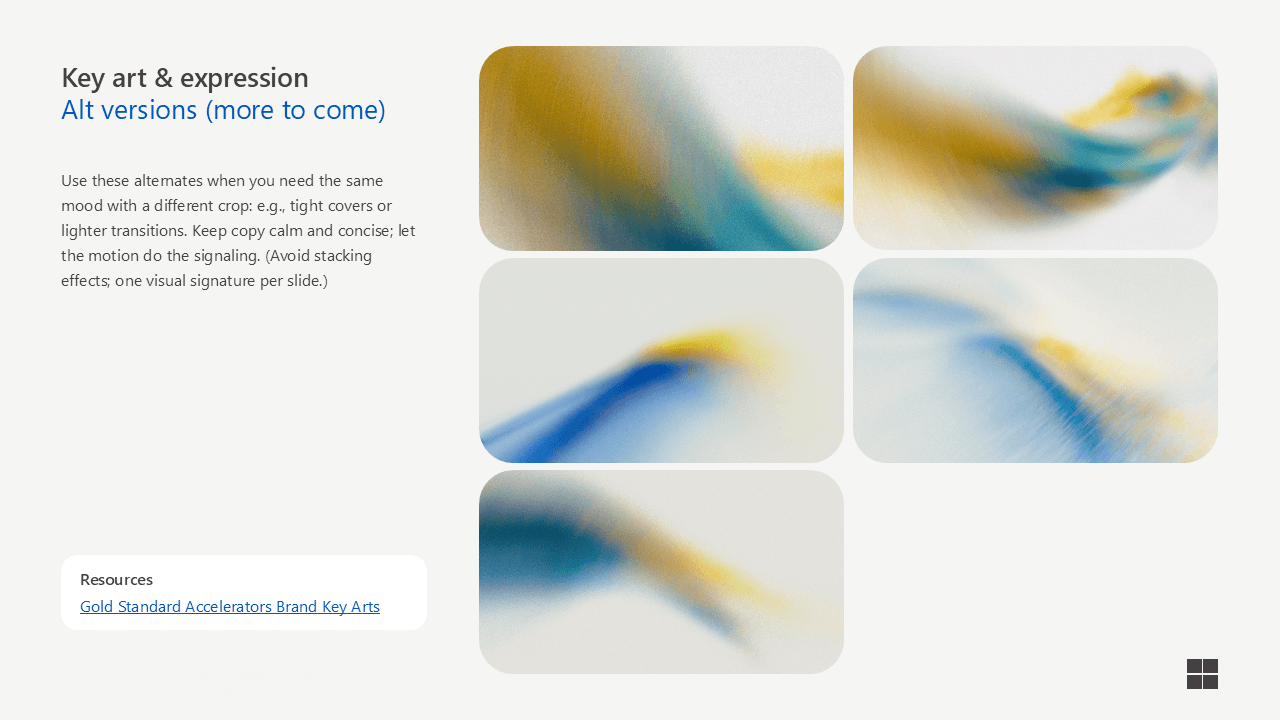
A governed key-art family created recognizable moments without separating GSA from Microsoft.

02 / CORE VISUAL SYSTEM

Shared rules across every visual layer

The interim system aligned hierarchy, color meaning, evidence assets, and signature expression into one internal production foundation.

TYPE & HIERARCHY

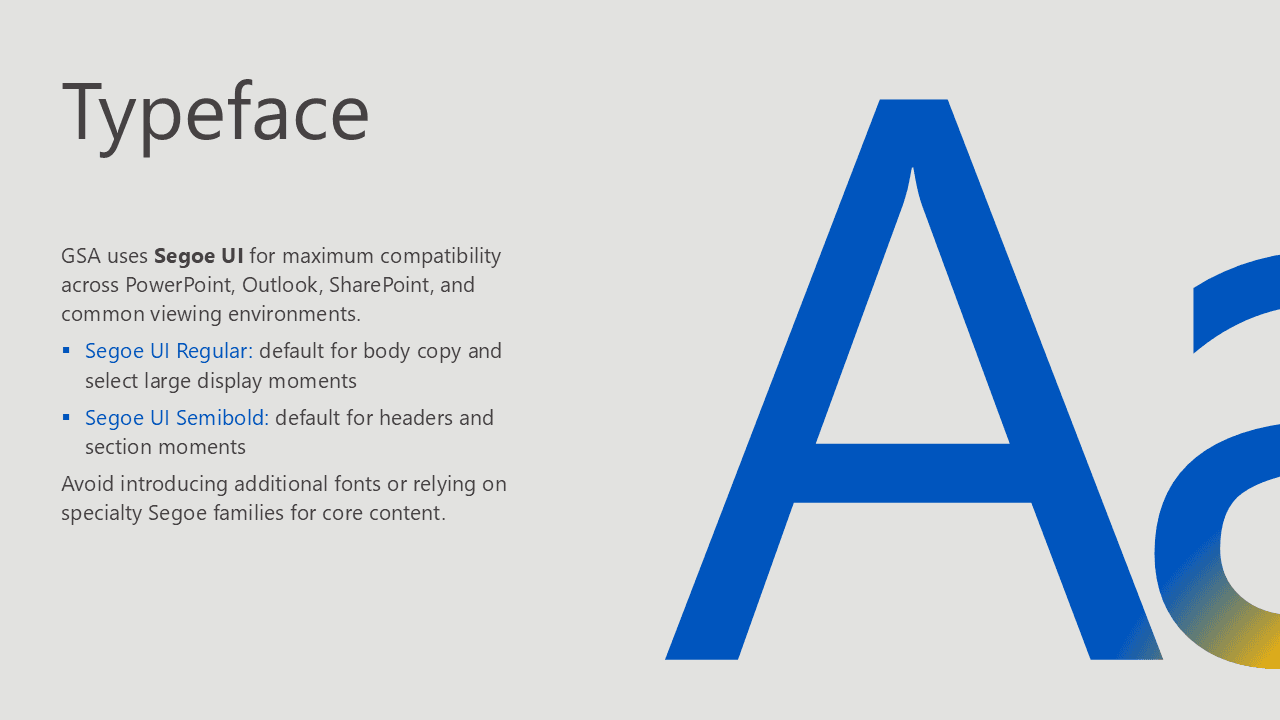
Segoe UI Regular and Semibold, supported by a controlled type ramp, established consistent hierarchy across internal GSA assets.

COLOR ROLES

A color-thoughtful palette organized neutrals, supporting tints, controlled accents, and dimensional anchors by function rather than decoration.

PHOTOGRAPHY

Authentic, inclusive, real-work imagery added credibility and human context while keeping the message primary.

ICONOGRAPHY

A consistent Fluent-aligned icon style made concepts, steps, and diagrams easier to scan without adding decorative noise.

KEY ART & EXPRESSION

One visual family supported three defined roles: hero moments, high-impact covers, and calmer section transitions.

03 / INTERNAL HANDOFF

Packaged for internal design-team use

The interim guideline was supported by reusable key-art resources and working layout references for early production.

ASSET RESOURCES

Approved key-art files were packaged as reusable resources for the internal design team.

WORKING LAYOUT REFERENCES

Three early layout directions provided shared reference points for limited internal applications.

PHASE BOUNDARY

Distributed internally and
used primarily by the design team

Limited early applications were created, but adoption and
usage were not tracked as a formal rollout.

NEXT

GSA evolves into the broader SAS system

01 / INTERIM SYSTEM OVERVIEW

A Microsoft-native visual foundation for GSA

The research was translated into a draft guideline and recognizable expression system for use by the internal design team.

INTERIM GUIDELINE

A draft visual-identity and design-system guideline created for internal use.

SIGNATURE EXPRESSION

A governed key-art family created recognizable moments without separating GSA from Microsoft.

02 / CORE VISUAL SYSTEM

Shared rules across every visual layer

The interim system aligned hierarchy, color meaning, evidence assets, and signature expression into one internal production foundation.

TYPE & HIERARCHY

Segoe UI Regular and Semibold, supported by a controlled type ramp, established consistent hierarchy across internal GSA assets.

COLOR ROLES

A color-thoughtful palette organized neutrals, supporting tints, controlled accents, and dimensional anchors by function rather than decoration.

PHOTOGRAPHY

Authentic, inclusive, real-work imagery added credibility and human context while keeping the message primary.

ICONOGRAPHY

A consistent Fluent-aligned icon style made concepts, steps, and diagrams easier to scan without adding decorative noise.

KEY ART & EXPRESSION

One visual family supported three defined roles: hero moments, high-impact covers, and calmer section transitions.

03 / INTERNAL HANDOFF

Packaged for internal design-team use

The interim guideline was supported by reusable key-art resources and working layout references for early production.

ASSET RESOURCES

Approved key-art files were packaged as reusable resources for the internal design team.

WORKING LAYOUT REFERENCES

Three early layout directions provided shared reference points for limited internal applications.

PHASE BOUNDARY

Distributed internally and used primarily by the design team

Limited early applications were created, but adoption and usage were not tracked as a formal rollout.

NEXT

GSA evolves into the broader SAS system

01 / INTERIM SYSTEM OVERVIEW

A Microsoft-native visual foundation for GSA

The research was translated into a draft guideline and recognizable expression system for use by the internal design team.

INTERIM GUIDELINE

A draft visual-identity and design-system guideline created for internal use.

SIGNATURE EXPRESSION

A governed key-art family created recognizable moments without separating GSA from Microsoft.

02 / CORE VISUAL SYSTEM

Shared rules across every visual layer

The interim system aligned hierarchy, color meaning, evidence assets, and signature expression into one internal production foundation.

TYPE & HIERARCHY

Segoe UI Regular and Semibold, supported by a controlled type ramp, established consistent hierarchy across internal GSA assets.

COLOR ROLES

A color-thoughtful palette organized neutrals, supporting tints, controlled accents, and dimensional anchors by function rather than decoration.

PHOTOGRAPHY

Authentic, inclusive, real-work imagery added credibility and human context while keeping the message primary.

ICONOGRAPHY

A consistent Fluent-aligned icon style made concepts, steps, and diagrams easier to scan without adding decorative noise.

KEY ART & EXPRESSION

One visual family supported three defined roles: hero moments, high-impact covers, and calmer section transitions.

03 / INTERNAL HANDOFF

Packaged for internal design-team use

The interim guideline was supported by reusable key-art resources and working layout references for early production.

ASSET RESOURCES

Approved key-art files were packaged as reusable resources for the internal design team.

WORKING LAYOUT REFERENCES

Three early layout directions provided shared reference points for limited internal applications.

PHASE BOUNDARY

Distributed internally and used primarily by the design team

Limited early applications were created, but adoption and usage were not tracked as a formal rollout.

NEXT

GSA evolves into the broader SAS system

I translated the research into an interim GSA expression system built on Microsoft-native foundations, including typography, color roles, photography, iconography, key art, and presentation guidance.

The guideline and asset package were distributed internally, with practical use concentrated within the design team. A limited number of early applications were created, but this phase was not tracked as a formal rollout. The system later became the starting point for the GSA-to-SAS evolution.

05 / FROM GSA TO SAS

Evolving an accelerator identity into a broader SAS system

The interim GSA foundation became a broader visual and verbal system designed to support an organization, not only an accelerator portfolio.

01 / THE TRANSITION

From an accelerator-focused foundation to an organizational system

GSA established the initial visual language. SAS expanded its purpose, audiences, communication contexts, and production tools.

INTERIM GSA

An accelerator-focused visual foundation for solution communications.

EXPANDED SCOPE

SCALE AI SOLUTIONING

A broader visual and verbal system for organizational and accelerator communications.

02 / EXPANDING THE SYSTEM

The system expanded from visual expression to organizational communication

The SAS system connected what the organization stood for, how it should communicate, and how its assets should work together.

BRAND PURPOSE

SAS reframed accelerator work as repeatable AI momentum delivered with Microsoft-level clarity and trust.

BRAND BEHAVIOR

Five behavior principles defined how SAS should feel across audiences and communication contexts.

BRAND ARCHITECTURE

The architecture connected Scale AI Solutioning, accelerators, storytelling contexts, guidelines, templates, and future communication assets.

AUDIENCE-AWARE VOICE

Messaging depth and emphasis changed for business leaders, technical leaders, sellers, and customer-facing roles.

VOICE PILLARS

The verbal system balanced bold clarity, enterprise confidence, momentum, modular structure, and Microsoft-native restraint.

Voice system primarily developed by Principal Designer Noah Pashley, with collaborative critique and integration into the broader SAS system.

03 / OPERATIONALIZED TOOLKIT

The system became a reusable production tool

The guidelines were translated into a PowerPoint template with instructional guidance, coordinated light and dark themes, and reusable layouts for common SAS storytelling needs.

REUSABLE POWERPOINT TEMPLATE

The visual and verbal system was packaged into a reusable .potx template with built-in guidance for additional creators.

REUSABLE LAYOUT SYSTEM

Reusable slide families translated the SAS system into common storytelling patterns.

TITLE

DARK TITLE

SECTION

CONTENT

PERSONA

JOURNEY / DIAGRAM

Title, section, content, persona, and journey layouts gave creators flexible structures without forcing every story into the same composition.

04 / COLLABORATION & HANDOFF

A shared system built through complementary ownership

MY CONTRIBUTION

Visual direction

Visual-system development

Presentation architecture

Brand-guideline design

PowerPoint template design and production

Integration of visual and verbal guidance

PARTNERSHIP

Principal Designer Noah Pashley primarily developed the SAS voice and contributed strategic critique throughout the system’s evolution.

Together, we connected the verbal and visual layers into one working brand system.

SYSTEM READY FOR APPLICATION

Working guidelines and a reusable SAS template created the foundation for field-ready solution stories.

NEXT

Applied across seven solution decks and 151 slides

01 / THE TRANSITION

From an accelerator-focused foundation to an organizational system

GSA established the initial visual language. SAS expanded its purpose, audiences, communication contexts, and production tools.

INTERIM GSA

An accelerator-focused visual foundation for solution communications.

EXPANDED
SCOPE

SCALE AI SOLUTIONING

A broader visual and verbal system for organizational and accelerator communications.

02 / EXPANDING THE SYSTEM

The system expanded from visual expression to organizational communication

The SAS system connected what the organization stood for, how it should communicate, and how its assets should work together.

BRAND PURPOSE

SAS reframed accelerator work as repeatable AI momentum delivered with Microsoft-level clarity and trust.

BRAND BEHAVIOR

Five behavior principles defined how SAS should feel across audiences and communication contexts.

BRAND ARCHITECTURE

The architecture connected Scale AI Solutioning, accelerators, storytelling contexts, guidelines, templates, and future communication assets.

AUDIENCE-AWARE VOICE

Messaging depth and emphasis changed for business leaders, technical leaders, sellers, and customer-facing roles.

VOICE PILLARS

The verbal system balanced bold clarity, enterprise confidence, momentum, modular structure, and Microsoft-native restraint.

Voice system primarily developed by Principal Designer Noah Pashley, with collaborative critique and integration into the broader SAS system.

03 / OPERATIONALIZED TOOLKIT

The system became a reusable production tool

The guidelines were translated into a PowerPoint template with instructional guidance, coordinated light and dark themes, and reusable layouts for common SAS storytelling needs.

REUSABLE POWERPOINT TEMPLATE

The visual and verbal system was packaged into a reusable .potx template with built-in guidance for additional creators.

REUSABLE LAYOUT SYSTEM

Reusable slide families translated the SAS system into common storytelling patterns.

Title, section, content, persona, and journey layouts gave creators flexible structures without forcing every story into the same composition.

04 / COLLABORATION & HANDOFF

A shared system built through complementary ownership

MY CONTRIBUTION

Visual direction

Visual-system development

Presentation architecture

Brand-guideline design

PowerPoint template design and production

Integration of visual and verbal guidance

PARTNERSHIP

Principal Designer Noah Pashley primarily developed the SAS voice and contributed strategic critique throughout the system’s evolution.

Together, we connected the verbal and visual layers into one working brand system.

SYSTEM READY FOR APPLICATION

Working guidelines and a reusable SAS template created the foundation for field-ready solution stories.

NEXT

Applied across seven solution decks and 151 slides

01 / THE TRANSITION

From an accelerator-focused foundation to an organizational system

GSA established the initial visual language. SAS expanded its purpose, audiences, communication contexts, and production tools.

INTERIM GSA

An accelerator-focused visual foundation for solution communications.

EXPANDED
SCOPE

SCALE AI SOLUTIONING

A broader visual and verbal system for organizational and accelerator communications.

02 / EXPANDING THE SYSTEM

The system expanded from visual expression to organizational communication

The SAS system connected what the organization stood for, how it should communicate, and how its assets should work together.

BRAND PURPOSE

SAS reframed accelerator work as repeatable AI momentum delivered with Microsoft-level clarity and trust.

BRAND BEHAVIOR

Five behavior principles defined how SAS should feel across audiences and communication contexts.

BRAND ARCHITECTURE

The architecture connected Scale AI Solutioning, accelerators, storytelling contexts, guidelines, templates, and future communication assets.

AUDIENCE-AWARE VOICE

Messaging depth and emphasis changed for business leaders, technical leaders, sellers, and customer-facing roles.

VOICE PILLARS

The verbal system balanced bold clarity, enterprise confidence, momentum, modular structure, and Microsoft-native restraint.

Voice system primarily developed by Principal Designer Noah Pashley, with collaborative critique and integration into the broader SAS system.

03 / OPERATIONALIZED TOOLKIT

The system became a reusable production tool

The guidelines were translated into a PowerPoint template with instructional guidance, coordinated light and dark themes, and reusable layouts for common SAS storytelling needs.

REUSABLE POWERPOINT TEMPLATE

The visual and verbal system was packaged into a reusable .potx template with built-in guidance for additional creators.

REUSABLE LAYOUT SYSTEM

Reusable slide families translated the SAS system into common storytelling patterns.

TITLE

DARK TITLE

SECTION

CONTENT

PERSONA

JOURNEY / DIAGRAM

Title, section, content, persona, and journey layouts gave creators flexible structures without forcing every story into the same composition.

04 / COLLABORATION & HANDOFF

A shared system built through complementary ownership

MY CONTRIBUTION

Visual direction

Visual-system development

Presentation architecture

Brand-guideline design

PowerPoint template design and production

Integration of visual and verbal guidance

PARTNERSHIP

Principal Designer Noah Pashley primarily developed the SAS voice and contributed strategic critique throughout the system’s evolution.

Together, we connected the verbal and visual layers into one working brand system.

SYSTEM READY FOR APPLICATION

Working guidelines and a reusable SAS template created the foundation for field-ready solution stories.

NEXT

Applied across seven solution decks and 151 slides

As GSA evolved into Scale AI Solutioning, the system needed to support a broader organizational identity, more communication contexts, and audiences ranging from business leaders to technical sellers.

I partnered with Principal Designer Noah Pashley to complete the SAS working brand system. I led visual direction, presentation architecture, guideline design, and template production, while Noah primarily developed the voice and contributed critique and strategic feedback.

06 / FIELD APPLICATION

Seven solution decks,
one field storytelling system

Seven solution decks,
one field storytelling system

Seven solution decks,
one field storytelling system

One shared system turned seven distinct AI solutions into a consistent field portfolio without flattening their differences.

01 / DELIVERED PORTFOLIO

A complete family of field-ready solution stories

The final system was applied across seven directly designed decks totaling 151 slides.

7

FIELD-READY DECKS

151

SLIDES DIRECTLY DESIGNED

SEISMIC

CENTRALIZED DISTRIBUTION

Chat With Your Data —
Employee Onboarding

Deploy Your AI Application in Production

Document Knowledge Mining

Intake Scoring Automation

Chat With Your Data

Conversation Knowledge Mining

Modernize Your Code

02 / STORY ARCHITECTURE IN PRACTICE

Different solutions,
the same field-ready rhythm

Each deck adapted the same core sequence from business value and user need to technical proof and product experience.


01 / BUSINESS VALUE

INTAKE SCORING AUTOMATION

Translate a complex solution into a small set of scannable business outcomes.


02 / PERSONA & SCENARIO

DOCUMENT KNOWLEDGE MINING

Ground technical capability in a specific user, problem, and desired outcome.

03 / USER JOURNEY

DEPLOY YOUR AI APPLICATION
IN PRODUCTION

Turn a complex deployment process
into a clear sequence of decisions and actions.

04 / KEY FEATURES

CONVERSATION KNOWLEDGE MINING

Organize core capabilities into a modular view that can be scanned quickly in field conversations.

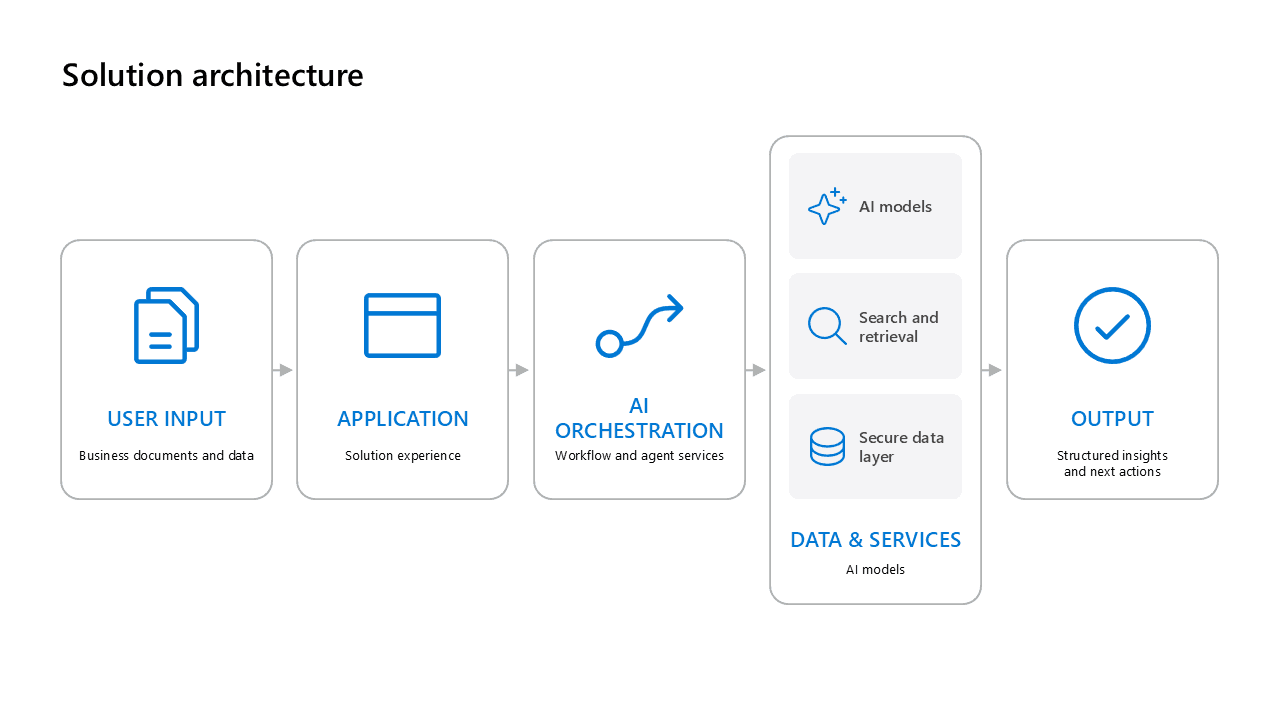
05 / TECHNICAL ARCHITECTURE

MODERNIZE YOUR CODE

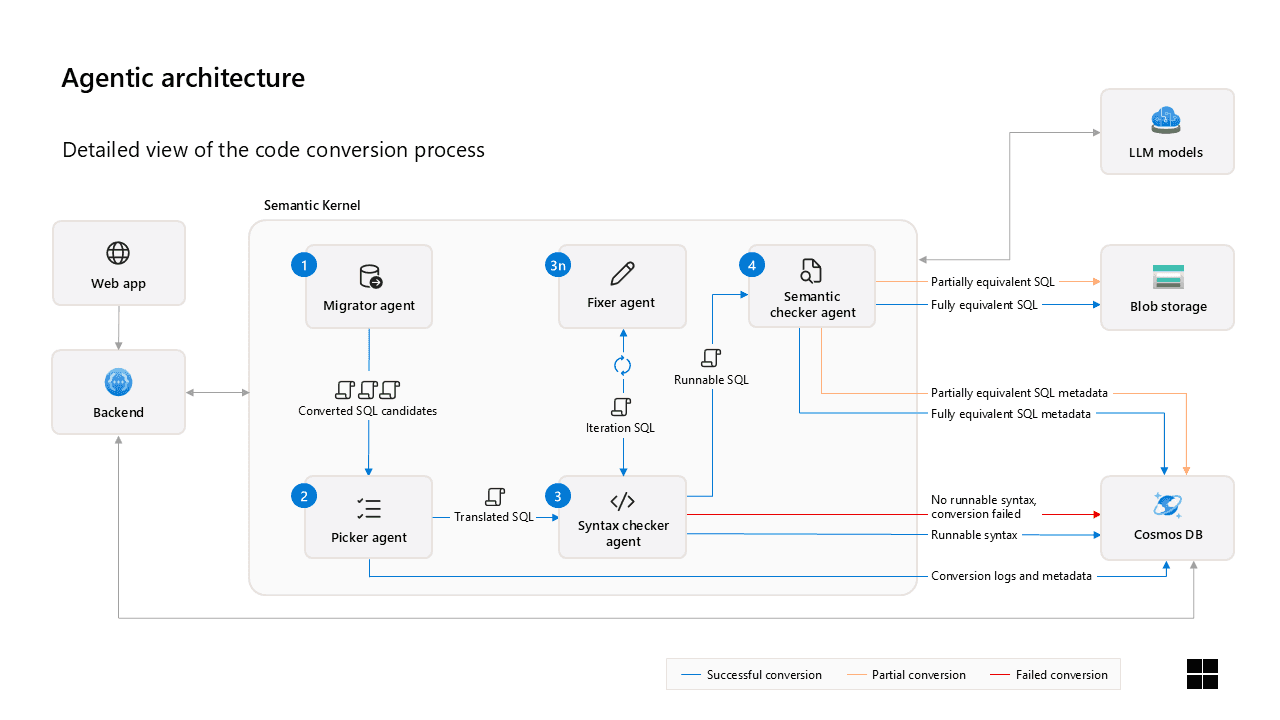
Translate a multi-agent technical process into a structured view of roles, dependencies, and outcomes.

06 / PRODUCT DEMONSTRATION

DOCUMENT KNOWLEDGE MINING

Connect the solution story to the product experience through a customer-ready click-through demonstration.

03 / FIELD DISTRIBUTION

Designed for discovery, presentation, and modular reuse

The completed portfolio was distributed through Seismic to support field discovery, full-deck presentation, section selection, and individual-slide reuse.

SYSTEM

SAS guidelines + PowerPoint template

PORTFOLIO

7 field-ready decks

151 slides

DISTRIBUTION

Seismic

Centralized field access

REUSE MODEL

Present a complete deck

Select relevant sections

Reuse individual slides

FIELD AUDIENCE & USE

SELLERS

ACCOUNT TEAMS

TECHNICAL FIELD ROLES

CUSTOMER-FACING CONVERSATIONS

VERIFIED OUTCOME

One shared system became a complete, reusable field portfolio across seven distinct AI solution stories.

DELIVERED

7 decks · 151 slides · Seismic distribution

01 / DELIVERED PORTFOLIO

A complete family of field-ready solution stories

The final system was applied across seven directly designed decks totaling 151 slides.

7

FIELD-READY DECKS

151

SLIDES DIRECTLY DESIGNED

SEISMIC

CENTRALIZED DISTRIBUTION

Chat With Your Data — Employee Onboarding

Deploy Your AI Application in Production

Document Knowledge Mining

Intake Scoring Automation

Chat With Your Data

Conversation Knowledge Mining

Modernize Your Code

02 / STORY ARCHITECTURE
IN PRACTICE

Different solutions,
the same field-ready rhythm

Each deck adapted the same core sequence from business value and user need to technical proof and product experience.

01 / BUSINESS VALUE

INTAKE SCORING AUTOMATION

Translate a complex solution into a small set of scannable business outcomes.

02 / PERSONA & SCENARIO

DOCUMENT KNOWLEDGE MINING

Ground technical capability in a specific user, problem, and desired outcome.

03 / USER JOURNEY

DEPLOY YOUR AI APPLICATION
IN PRODUCTION

Turn a complex deployment process into a clear sequence of decisions and actions.

04 / KEY FEATURES

CONVERSATION KNOWLEDGE MINING

Organize core capabilities into a modular view that can be scanned quickly in field conversations.

05 / TECHNICAL ARCHITECTURE

MODERNIZE YOUR CODE

Translate a multi-agent technical process into a structured view of roles, dependencies, and outcomes.

06 / PRODUCT DEMONSTRATION

DOCUMENT KNOWLEDGE MINING

Connect the solution story to the product experience through a customer-ready click-through demonstration.

03 / FIELD DISTRIBUTION

Designed for discovery, presentation, and modular reuse

The completed portfolio was distributed through Seismic to support field discovery, full-deck presentation, section selection, and individual-slide reuse.

SYSTEM

SAS guidelines + PowerPoint template

PORTFOLIO

7 field-ready decks

151 slides

DISTRIBUTION

Seismic

Centralized field access

REUSE MODEL

Present a complete deck

Select relevant sections

Reuse individual slides

FIELD AUDIENCE & USE

SELLERS

ACCOUNT TEAMS

TECHNICAL FIELD ROLES

CUSTOMER-FACING CONVERSATIONS

VERIFIED OUTCOME

One shared system became a complete, reusable field portfolio across seven distinct AI solution stories.

DELIVERED

7 decks · 151 slides · Seismic distribution

01 / DELIVERED PORTFOLIO

A complete family of field-ready solution stories

The final system was applied across seven directly designed decks totaling 151 slides.

7

FIELD-READY DECKS

151

SLIDES DIRECTLY DESIGNED

SEISMIC

CENTRALIZED DISTRIBUTION

Chat With Your Data —
Employee Onboarding

Deploy Your AI Application in Production

Document Knowledge Mining

Intake Scoring Automation

Chat With Your Data

Conversation Knowledge Mining

Modernize Your Code

02 / STORY ARCHITECTURE IN PRACTICE

Different solutions,
the same field-ready rhythm

Each deck adapted the same core sequence from business value and user need to technical proof and product experience.


01 / BUSINESS VALUE

INTAKE SCORING AUTOMATION

Translate a complex solution into a small set of scannable business outcomes.


02 / PERSONA & SCENARIO

DOCUMENT KNOWLEDGE MINING

Ground technical capability in a specific user, problem, and desired outcome.

03 / USER JOURNEY

DEPLOY YOUR AI APPLICATION
IN PRODUCTION

Turn a complex deployment process into a clear sequence of decisions and actions.


04 / KEY FEATURES

CONVERSATION KNOWLEDGE MINING

Organize core capabilities into a modular view that can be scanned quickly in field conversations.

05 / TECHNICAL ARCHITECTURE

MODERNIZE YOUR CODE

Translate a multi-agent technical process into a structured view of roles, dependencies, and outcomes.

06 / PRODUCT DEMONSTRATION

DOCUMENT KNOWLEDGE MINING

Connect the solution story to the product experience through a customer-ready click-through demonstration.

03 / FIELD DISTRIBUTION

Designed for discovery, presentation, and modular reuse

The completed portfolio was distributed through Seismic to support field discovery, full-deck presentation, section selection, and individual-slide reuse.

SYSTEM

SAS guidelines + PowerPoint template

PORTFOLIO

7 field-ready decks

151 slides

DISTRIBUTION

Seismic

Centralized field access

REUSE MODEL

Present a complete deck

Select relevant sections

Reuse individual slides

FIELD AUDIENCE & USE

SELLERS

ACCOUNT TEAMS

TECHNICAL FIELD ROLES

CUSTOMER-FACING CONVERSATIONS

VERIFIED OUTCOME

One shared system became a complete, reusable field portfolio across seven distinct AI solution stories.

DELIVERED

7 decks · 151 slides · Seismic distribution

After the SAS guidelines and PowerPoint template were completed, I applied the system across seven field-ready Solution Accelerator decks totaling 151 slides.

Working with solution owners and technical stakeholders, I translated each solution into a field-ready story using a shared presentation architecture. Across the portfolio, the decks covered business value, customer challenges, personas and scenarios, user journeys, technical architecture, repository access, and product demonstrations.

The completed decks were distributed through Seismic for seller, account-team, and technical-field discovery and reuse.

Evidence Boundary


What this case study demonstrates

and where the evidence ends

I directly designed the initial GSA template and the interim GSA visual system.

During the SAS phase, I led the visual system, presentation architecture, guideline design, and production in partnership with Principal Designer Noah Pashley, who primarily developed the voice.

After the SAS system and template were completed, I directly designed seven field-ready Solution Accelerator decks totaling 151 slides.

Solution owners and technical stakeholders supplied or validated the underlying product and technical content.

CONFIDENTIALITY NOTE

This case study uses reconstructed, redacted, or placeholder content to protect confidential information. Product messaging, internal links, customer details, technical specifications, source-code information, and unreleased solution content have been removed, obscured, or replaced.