Human-in-the-Loop AI

Overview
AI Agent Lab reframes AI-assisted presentation work from a generation shortcut into a structured workflow for communication quality.
The project started with a familiar promise: rough input goes in, a deck comes out. But the more important question was whether the output actually worked — whether it had the right narrative structure, audience posture, communication register, brand fit, and level of editorial judgment.
I designed a modular AI workflow that separates generation, evaluation, and human judgment. The goal was not to replace the designer. It was to make AI-assisted communication easier to structure, review, and improve.
The project produced a documented AI workflow system with separated generation and evaluation layers, reusable narrative skills, sourced brand profiles, evidence-typed findings, and validation runs that show both system strengths and limitations.
Role
I designed the workflow logic, agent roles, handoff architecture, prompt system, evaluation criteria, and human decision points.
Audience
Designers · Communication leads · Executive storytellers · Teams building recurring leadership narratives or evaluating AI-assisted communication quality
Scope
Prototype workflow · Executive Storyline Agent · Independent Review Agent · Shared narrative skills · Sourced brand profiles · Synthetic demo run · Validation runs · Selected evaluation artifacts
Tools / Methods
Claude in VS Code
Microsoft Copilot
PowerPoint
Prompt design
Workflow mapping
Narrative systems design
Register taxonomy
Presentation-quality review
Visual communication design
01 / Problem
AI could generate slides. Generation alone could not tell if they worked.
The problem was not speed. It was communication quality.

The earliest version of the project treated AI as a faster way to create presentations. But the first structured reviews revealed a deeper problem.
Generated decks could look finished while still failing in ways that mattered: the wrong register for the audience, unsafe speaker notes, layout issues that only appeared after rendering, or a story that sounded coherent but missed the communication intent.
That changed the project brief. The goal was no longer to generate better slides. It was to design a workflow that could evaluate whether the communication was actually working.
02 / Separation
A system that creates the output should not be the only system judging it.



The key design decision was to separate production from evaluation.
One layer generates the storyline and presentation structure. A second layer reviews the output without rewriting it. Human judgment stays responsible for strategic intent, editorial decisions, and final readiness.
That separation turned the project from a deck generator into an AI communication workflow.

03 / Workflow
A workflow for moving from rough input to clearer communication.
The system structures ambiguity before it produces artifacts.
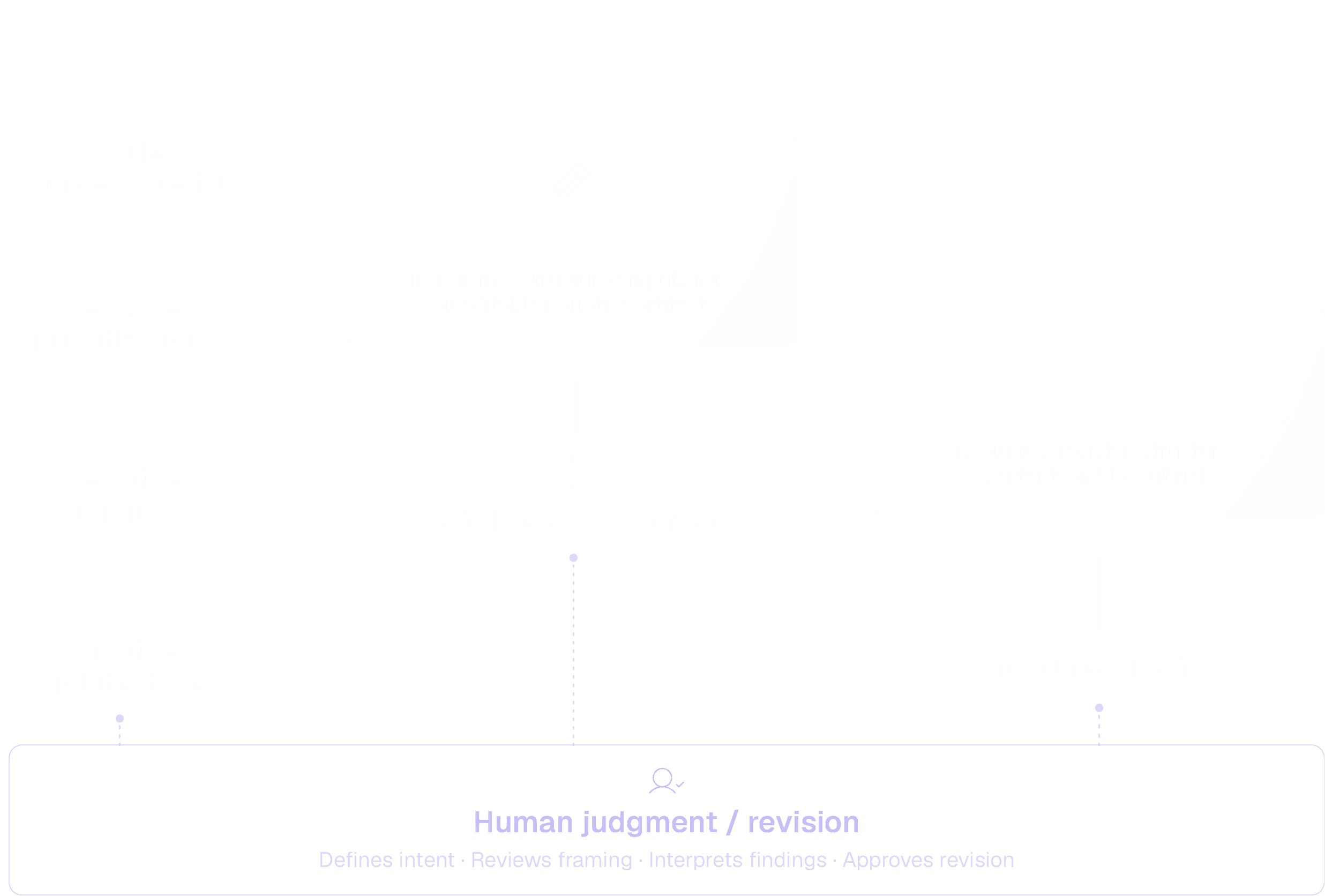
The workflow connects raw notes, message prioritization, executive framing, storyline generation, presentation-quality review, brand-aware checks, and human intervention.
Each step has a specific role. Shared skills help structure the message. The generation layer creates the draft artifact. The evaluation layer reviews the output against communication criteria. Human judgment decides what should change.
The result is not a one-click deck. It is a repeatable workflow for turning ambiguous material into clearer executive communication.
04 / VALIDATION
Three validation runs tested the workflow’s range—
not just its best case.
The strongest result showed the system’s potential.
The transfer test revealed its boundary.
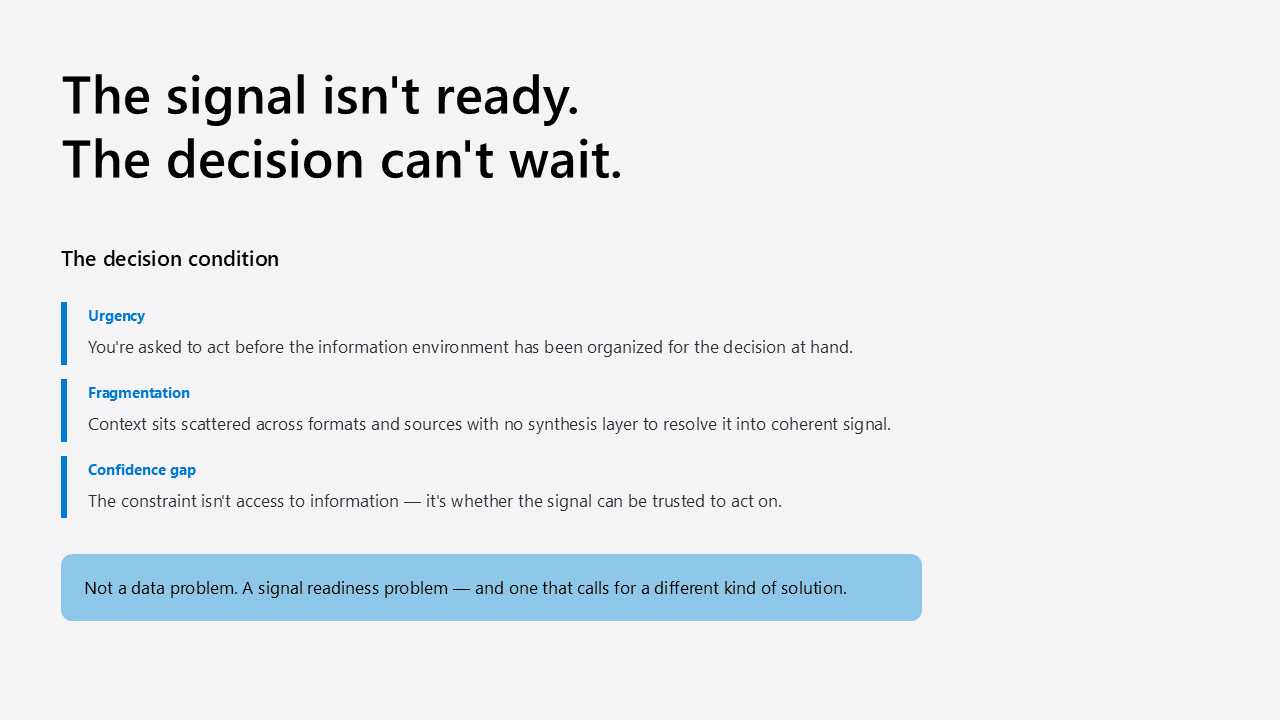
The prototype was tested through three runs built around different communication conditions. Rather than selecting a single polished success, the runs examined how the workflow responded to rough input, aligned executive intent, and customer-facing transfer.


05 / Design Insight
A correct structure can still carry the wrong communication posture.
The strongest boundary test produced a structurally coherent, visually resolved deck—but the language remained analytical when the brief required a customer-facing voice.
The evaluator could identify the mismatch and distinguish what still worked from what needed reframing. Human judgment was still required to decide how the message should feel, what needed reframing, and which parts of the structure should remain intact.

06 / Impact
The lab turned one-off generation into a system that can be tested, improved, and extended.
By the end of the prototype, the work had become more than a deck-generation workflow. It became a reusable foundation for narrative generation, evaluation, and iteration.
The system is strongest today in executive narrative work. The next phase is to expand the agent and skill library for customer-facing, product, and recurring communication use cases.
The goal is not broader automation for its own sake. It is a more adaptable system that can match narrative logic, communication posture, and visual structure to the job at hand.
Evidence Boundary
What this case study demonstrates—
what it does not claim
This case study documents a working prototype, reusable system components, and a series of structured validation runs. The evidence demonstrates how the workflow generates, evaluates, and improves communication across different conditions.
It does not claim production deployment, organization-wide adoption, or measured business impact.
CONFIDENTIALITY NOTE
Selected examples use synthetic or portfolio-safe content where necessary. Confidential source material, customer information, and internal implementation details have been omitted.
